BIRDING IN AUSTRALIA
White Quilled Honeyeater
White Quilled Honeyeater
Species Stories · Northern Territory
So, Is It a Blue-faced Honeyeater… Or a White-quilled?
Darwin’s most familiar honeyeater has been living under the wrong name — and most field guides still haven’t caught up.
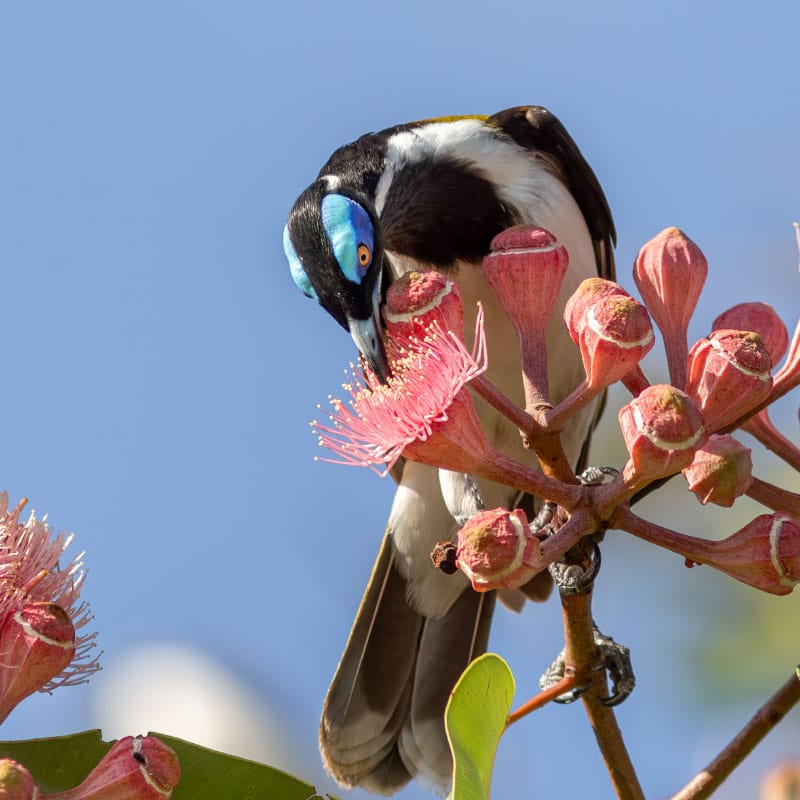
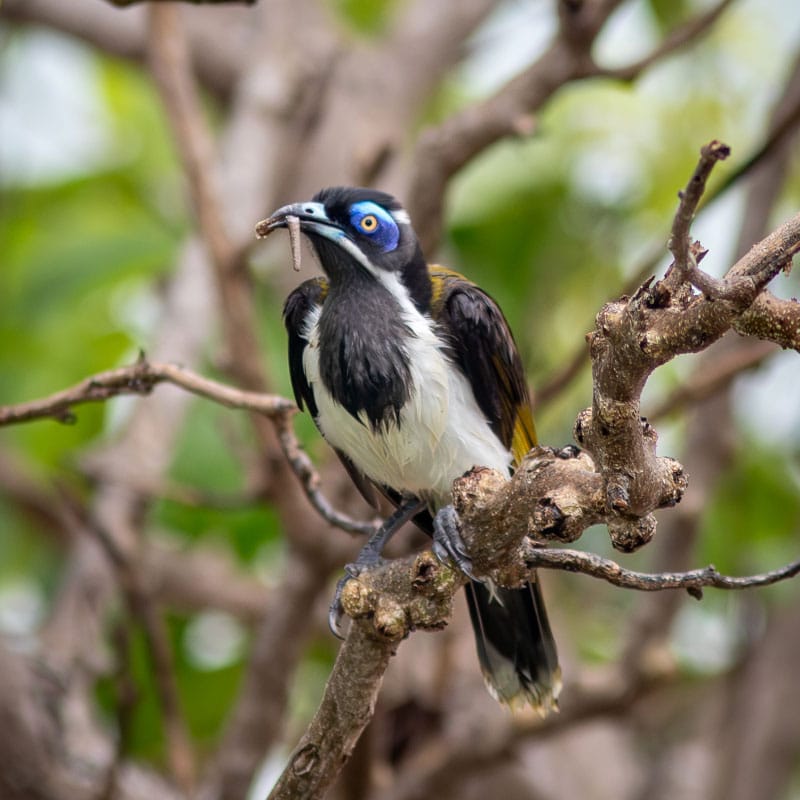
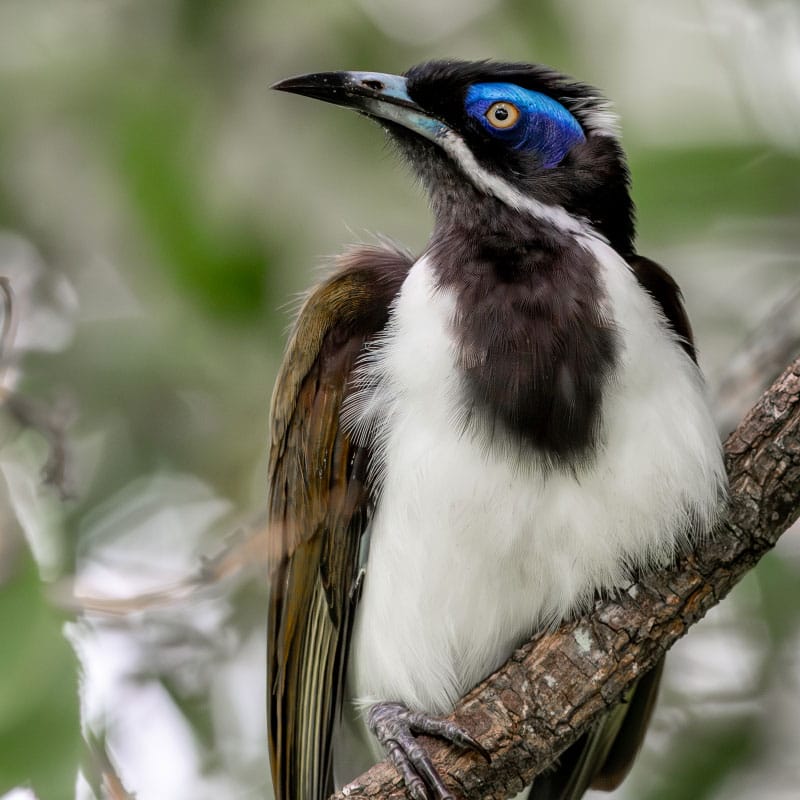
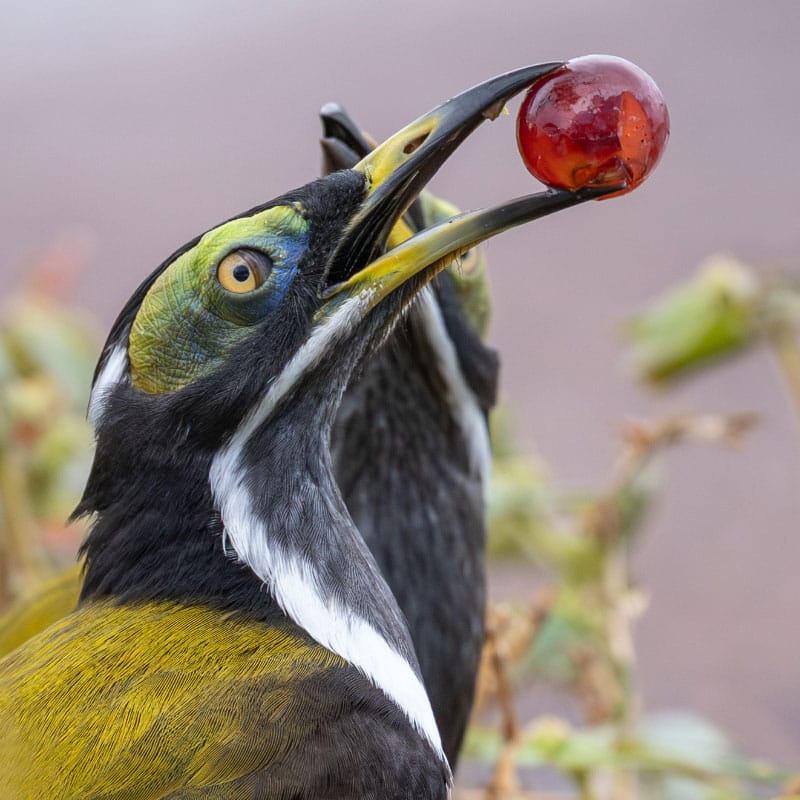
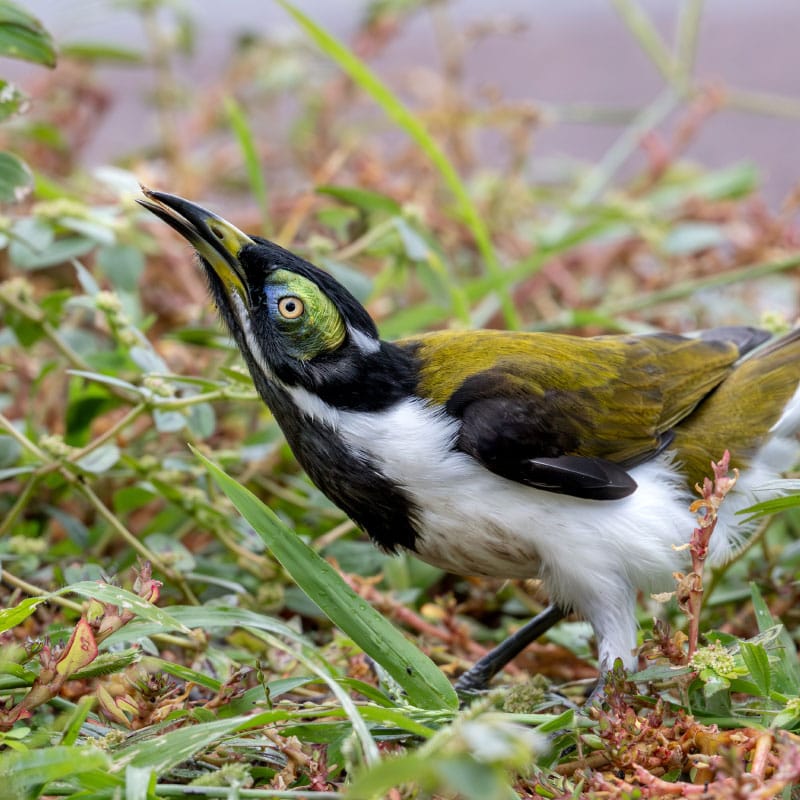
There is a bird outside my window right now. It has been outside my window most mornings since I arrived in Darwin — loud, opinionated, and completely unbothered by the fact that birding apps across the country can’t quite agree on what to call it. It is large for a honeyeater, dressed in a bold black bib and golden olive coat, and it has those extraordinary electric-blue patches around its eyes that look less like feathers and more like someone applied cobalt paint with great conviction. The locals call it the Banana Bird. Your older field guide calls it the Blue-faced Honeyeater. But up here, in the tropical north, science has quietly reassigned it — and the new name does confuse me somewhat, but I’ll run with it. This is the White-quilled Honeyeater. And it has earned its own story.
A Name Change Long Overdue
For most of the twentieth century, the bird we see across Darwin, the Kimberley, and the entire Top End was considered a straightforward subspecies of the Blue-faced Honeyeater — Entomyzon cyanotis albipennis — one of three recognised forms strung out across northern and eastern Australia. The name albipennis (from the Latin for ‘white-winged’) had been given by John Gould as far back as 1841, with the type specimen collected at Port Essington in the Northern Territory. The white wing patches were noticed from the very beginning. Taxonomy, however, moves at its own unhurried pace.
It was the BirdLife Australia Working List that finally drew the line, recognising the Top End bird as a full species in its own right: Entomyzon albipennis, the White-quilled Honeyeater. eBird reflected the change in its August 2017 taxonomy update, and the Handbook of the Birds of the World (HBW Alive) followed. The logic was compelling: the northern birds are consistently distinct in their prominent white primary patches — visible as a bright flash in flight — and the two populations occupy entirely different biogeographic zones with minimal overlap.
The white wing patches were noticed from the very beginning — Gould named the bird albipennis in 1841. It just took the rest of the taxonomic world a hundred and seventy-six years to catch up.
Here is where it gets interesting for those of us in the field: the split is not yet universally adopted. The International Ornithologists’ Union (IOC) — whose list many apps and older printed guides follow — still treats the northern bird as a subspecies group of the Blue-faced Honeyeater, rendering it as Entomyzon cyanotis (White-quilled). So if you open a popular identification app and find yourself staring at “Blue-faced Honeyeater (White-quilled),” that is not an error — it is simply the IOC list speaking. Update your app to its latest version, or switch to a BirdLife Australia–aligned checklist, and the bird resolves into its own full species. Taxonomy in motion.
Two Birds, Two Worlds
Once you accept the split, the geography becomes elegant. Australia’s northern arc — from the Kimberley across the Top End to the far northwest of Queensland’s Gulf Country — belongs to the White-quilled Honeyeater. It is sedentary up here, a year-round resident in a landscape that already offers everything it needs: monsoon forest, paperbarks along the creeks, pandanus palms, the shady sprawl of banyan figs, and the nectar-heavy flowers of Darwin’s parks and gardens. It does not need to wander.
The Blue-faced Honeyeater, Entomyzon cyanotis, takes the east — from Queensland’s Cape York south through the length of the coast, across New South Wales, into Victoria and as far as the Murray River towns of South Australia. Its world is broader, its movements more nomadic in the south, where food availability shifts with the seasons. It also ventures into Papua New Guinea. The two species do not regularly overlap in range, and where the map grows uncertain — around the Gulf of Carpentaria — birders with sharp eyes and updated apps are doing the important work of documenting exactly where one ends and the other begins.
In the Field: What to Look For
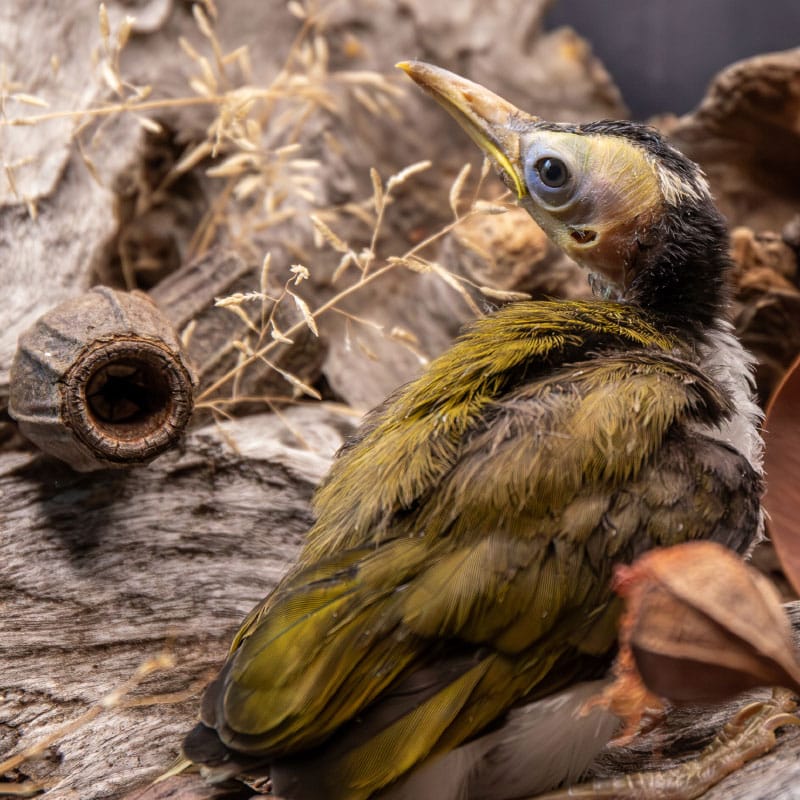
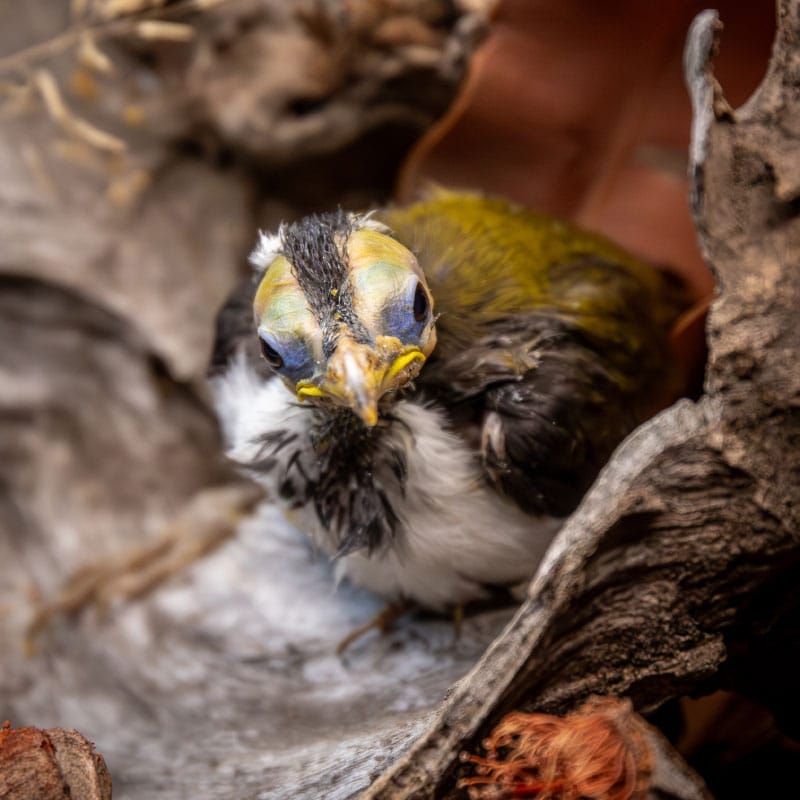
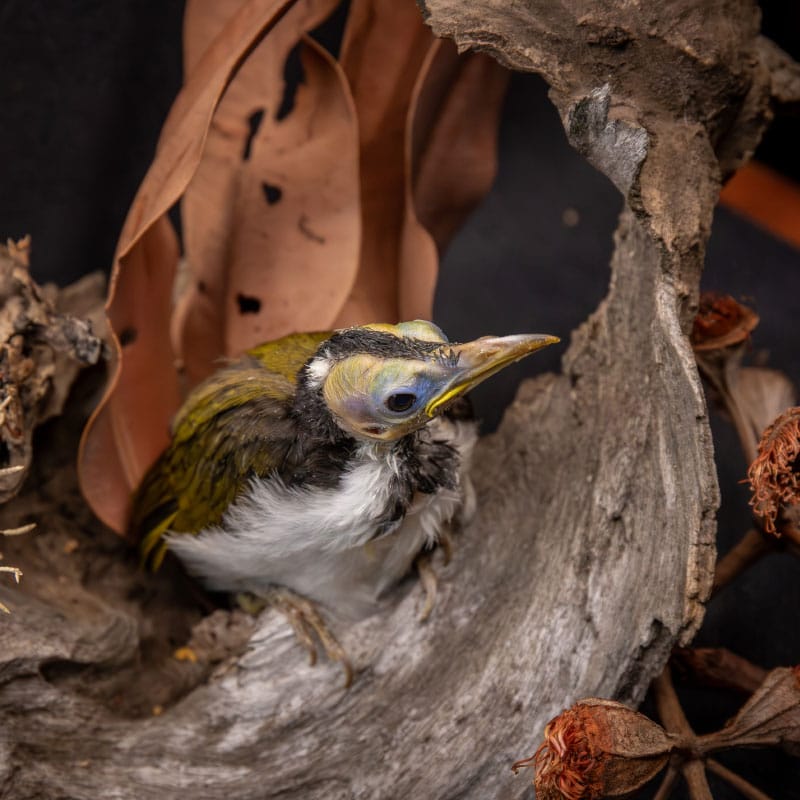
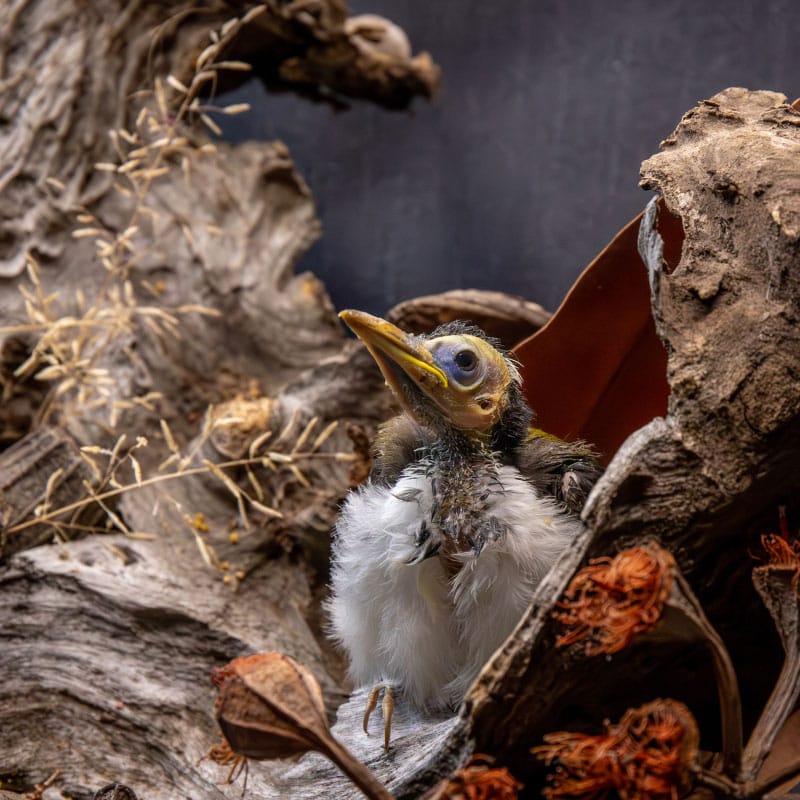
Both species share the family resemblance — the coal-black head and bib, the white nape stripe, the golden olive back, the clean white underparts. The face is the thing: that naked patch of brilliant cobalt skin around the eye, two-toned in adults with the lower half a deeper, almost electric blue. Juveniles carry yellow-green facial skin that slowly shifts through adolescence toward that adult blue, giving younger birds a slightly startled, wide-eyed look that somehow suits them.
The White-quilled’s signature is in the wing. In flight — and these birds move through the canopy with confident speed — the primary feathers catch the light in a clean white flash that the eastern Blue-faced simply does not produce in the same way. Stand under a Darwin fig tree as a small clan moves through, and you will see it: that white signal, repeatedly, as the birds turn and dive between branches. It is less a field mark and more a small celebration.
The Social Life: Helpers, Thieves & Clan Politics
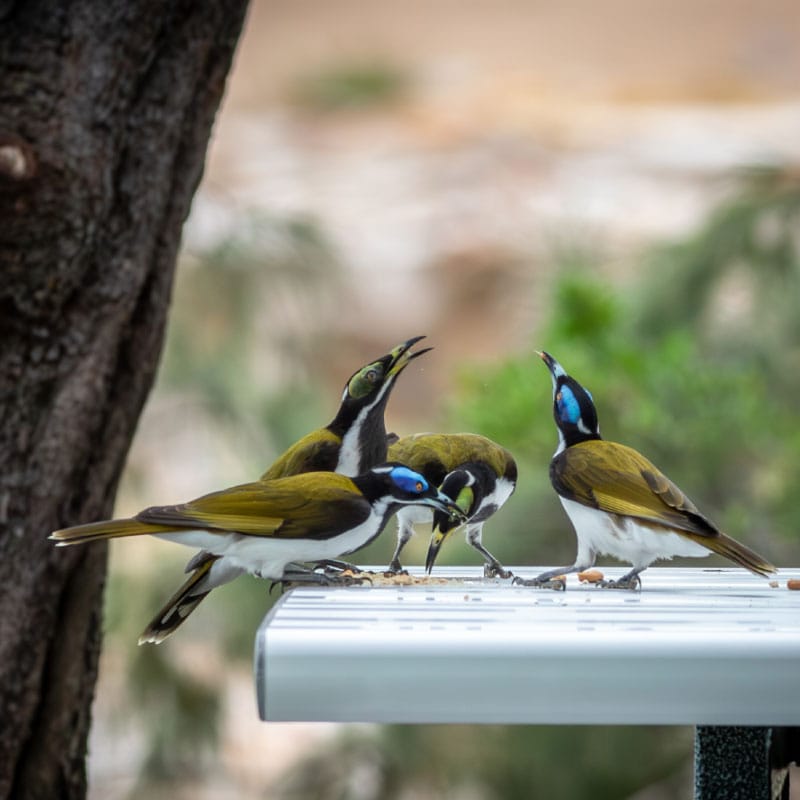
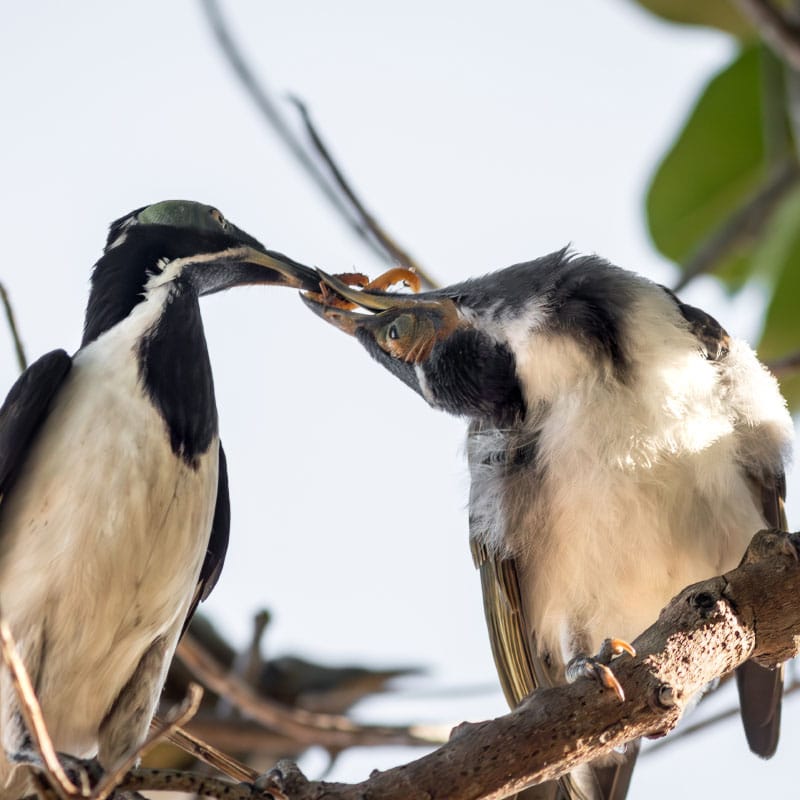
What makes this bird genuinely fascinating — beyond the identity debate — is the way it organises its family. The White-quilled Honeyeater is a cooperative breeder. The dominant pair holds a territory, but they rarely raise their young alone. Offspring from previous seasons — birds that have not yet bred themselves — stay on as helpers, feeding nestlings, guarding the nest, and joining the mob when a predator comes too close. Research on the eastern form suggests that most nests are attended by one to three helpers, and that pairs without helpers are measurably less successful. It is not charity; it is a strategy. Stay, learn, inherit.
Their nesting habits also reveal a certain opportunistic pragmatism. Rather than build from scratch, they prefer to renovate. The abandoned nests of Grey-crowned Babblers, Noisy Miners, Little Friarbirds, and even Australian Magpies are assessed, claimed, relined with fine bark and grass, and put to use. In Darwin, the base of palm fronds is a favoured site — the overhanging leaves providing cover from above that a predator’s eye might miss. Females incubate alone, laying two or rarely three pinkish eggs blotched with red-brown. Both parents and helpers then take up feeding duties for the three weeks until the chicks fledge.
These birds are also fiercely territorial about food. A small clan will move through a garden or woodland and simply exclude other species from their feeding area — not always violently, but with the calm authority of those who know they are larger than most of what surrounds them. The notable exception is the Yellow-throated Miner, with whom they maintain an uneasy co-existence — competing over fruit and nectar at one moment, and jointly mobbing a snake or kookaburra the next.
The Morning Bird
One local name for this bird is the Morning Bird — and it earns the title. It is consistently one of the first voices in Darwin’s pre-dawn, often calling thirty minutes before sunrise, while the rest of the canopy is still dark and silent. That call — a repeated, penetrating woik, or a rising weet-weet-weet at first light — is something you will hear before you see it. Once your ear is tuned to it, Darwin mornings will never feel quiet again.
Darwin’s Most Discerning Café Regular
Other Australian cities have their own species of opportunist. Sydney and Brisbane contend with the Bin Chicken — the Australian White Ibis, magnificent in the wetlands and magnificently unbothered in a food court. Melbourne has its cheeky magpies, who will assess your sandwich with the cold eye of a food critic. Coastal towns from Cairns to Albany are lorded over by Silver Gulls who have long since stopped pretending to be wild. Darwin, as in most things, does things a little differently. The White-quilled Honeyeater has cultivated an entirely more refined café culture.
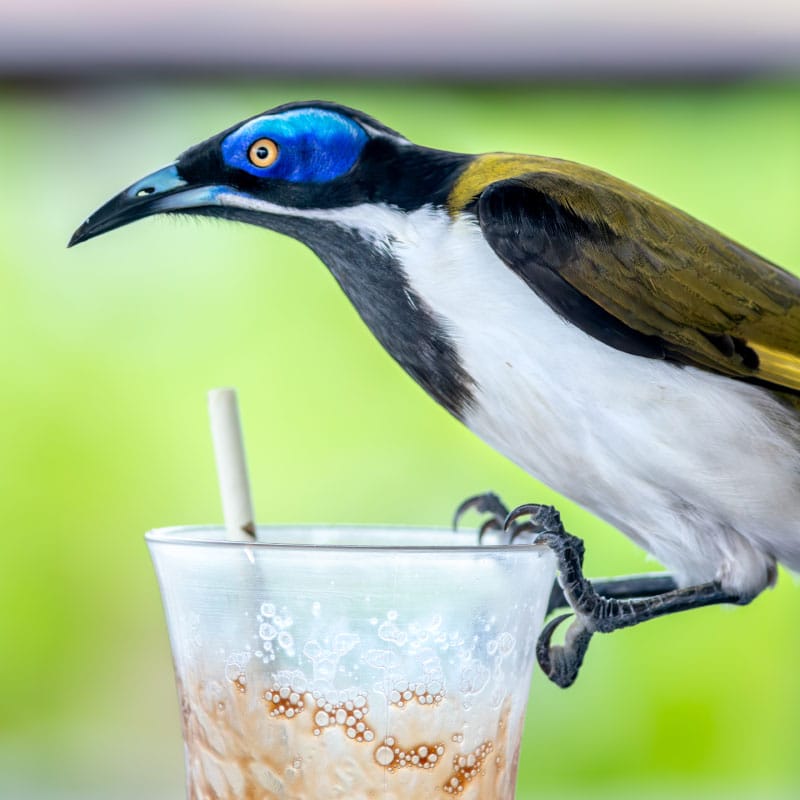
These birds have developed a well-documented reputation for working Darwin’s alfresco dining scene with considerable confidence. They are not thieves, exactly — more like uninvited guests who assume their company is welcome and have yet to be corrected. A saucer of sugar, an unguarded slice of mango, the dregs of a fruit smoothie — all are investigated with that characteristic tilted-head curiosity. One was recently spotted at Cullen Bay, working its way through an abandoned smoothie with the focused application of a bird that has made its peace with the tourism industry. The straw, apparently, presented no obstacle whatsoever. Darwin birders, naturally, have strong opinions about which café has the best regulars.
The Banana Bird Question
The nickname Banana Bird follows this species wherever bananas are grown across the tropical north. It is earned. These birds will investigate a bunch of bananas with the dedicated curiosity of someone who has been told there is something worth finding there and intends to confirm it personally. In commercial plantations they can cause enough damage to be considered a genuine pest — a status most birders find quietly amusing, given the bird’s otherwise impeccable reputation. They also feed on the flowers themselves, and given the banana’s dependence on animals for pollination, the relationship is rather more mutual than the farmers might admit.
In Darwin’s gardens, they are drawn to the flowers of natives and exotics alike. A flowering Grevillea or Callistemon will bring them in reliably. But it is insects — beetles, cockroaches, grasshoppers, and whatever else can be found probing the bark and undersides of branches — that make up the bulk of their actual diet. The nectar is dessert. The fruit is an indulgence. The café smoothie is apparently a treat. The insects are the work.
Where to Find Them in Darwin
The short answer is: almost anywhere with trees. The White-quilled Honeyeater is one of Darwin’s most reliably visible birds. East Point Reserve, the Darwin Botanic Gardens, Holmes Jungle Nature Park, and the leafy streets of suburbs like Fannie Bay and Parap will all produce sightings within minutes on most days. Early morning is best — not because they hide later, but because that pre-dawn calling makes them easy to locate before the day heats up and activity slows.
Melville Island is also worth noting — the population there falls within the White-quilled’s confirmed range, making island birding trips a chance to tick this species in a setting that feels, appropriately, like the very edge of the known world.
And if patience isn’t your strong suit, try the Cullen Bay café strip. Order a smoothie. Leave it unguarded for thirty seconds. Results may vary, but the odds are better than you’d think.
A Note for Your Lifers List
If you are keeping a lifers list — and if you are here, you probably are — the practical advice is this: update your apps. eBird, when set to the BirdLife Australia taxonomy, will list the White-quilled Honeyeater as a full species. Older Pizzey & Knight editions, the first editions of the Menkhorst field guide, and any app that hasn’t updated its checklist in the past few years will likely still show the Blue-faced Honeyeater for Darwin birds. The most recent editions of the major Australian field guides are catching up, but the lag is real, and it catches visitors out regularly.
The bird does not mind. It was sitting in that paperbark at Port Essington when Gould’s collectors arrived in 1841, white wing patches and all, already entirely itself. The name is just us trying to keep up.
Whatever your app calls it — and that depends entirely on which checklist it follows — the bird itself remains indifferent to the debate. It was here before the taxonomists arrived, and it will be here long after the next revision. Probably working a café somewhere nearby.
And a more personal story… Edward.
I had the joy of raising a White-quilled Honeyeater rescue. If you would like to read his story, you can find it here… Edward, my white-faced honeyeater rescue…
Story © Birding in Australia
Bird Images © Petra Hughes
(unless otherwise stated)
Please don’t copy, reproduce, or use any of the images or stories on Birding in Australia in any form without written permission.