BIRDING IN AUSTRALIA
Feathers in the Wind: Birds in Art, Myth & Storytelling Across Australia
Feathers in the Wind: Birds in Art, Myth & Storytelling Across Australia
Across Australia’s ancient landscapes, birds do more than inhabit sky and scrub — they carry voice through art and story, song and memory. In the shimmer of wetlands, within ochre-etched rock and across the pages of storybooks, birds hold meaning that stretches back through millennia. Their forms and calls have shaped tales of creation, seasons, Country and kin.
The Brolga — Dance of Dawn
Tall figures in grey, the brolga moves as though wind and water lent rhythm to its bones. In Indigenous storytelling, the brolga appears not just as bird, but as dancer and teacher — a being whose elegant motions speak of balance, celebration and connection to land. In some First Nations narratives, dance itself carries the whisper of ancestral footprints, and the brolga figures in stories of transformation and enduring song.
In visual art, this striking bird is a recurring motif — its poised silhouette and raised wings echoing ceremony, movement and Country itself. These depictions remind us that dance is not merely performance, but language.
The Bush Stone-Curlew — Night’s Wild Song
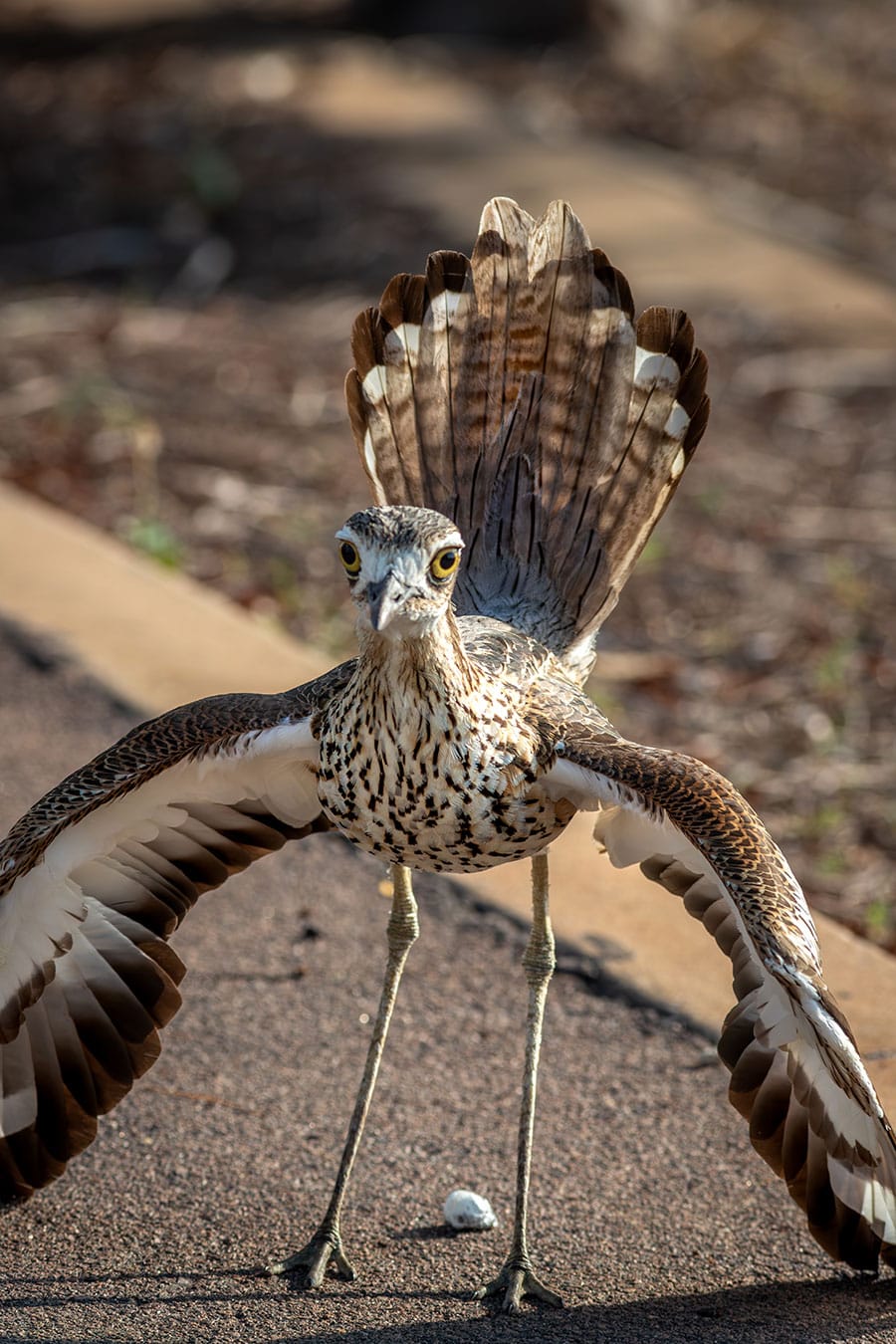
When twilight descends, the wailing call of the bush stone-curlew weaves through stillness — a sound both haunting and unforgettable. Across Australia, this bird has gathered folklore around its voice, which cuts through the dark like a warning or lament. Known in some regions by names such as buruwagan, the curlew’s call has long been associated with dusk, vigilance and the unseen movements of night.
In storytelling, its cry often marks a threshold — between day and night, safety and uncertainty, the known and the mysterious. The curlew’s presence in art and story reminds listeners to pay attention, to listen closely to the land after dark.
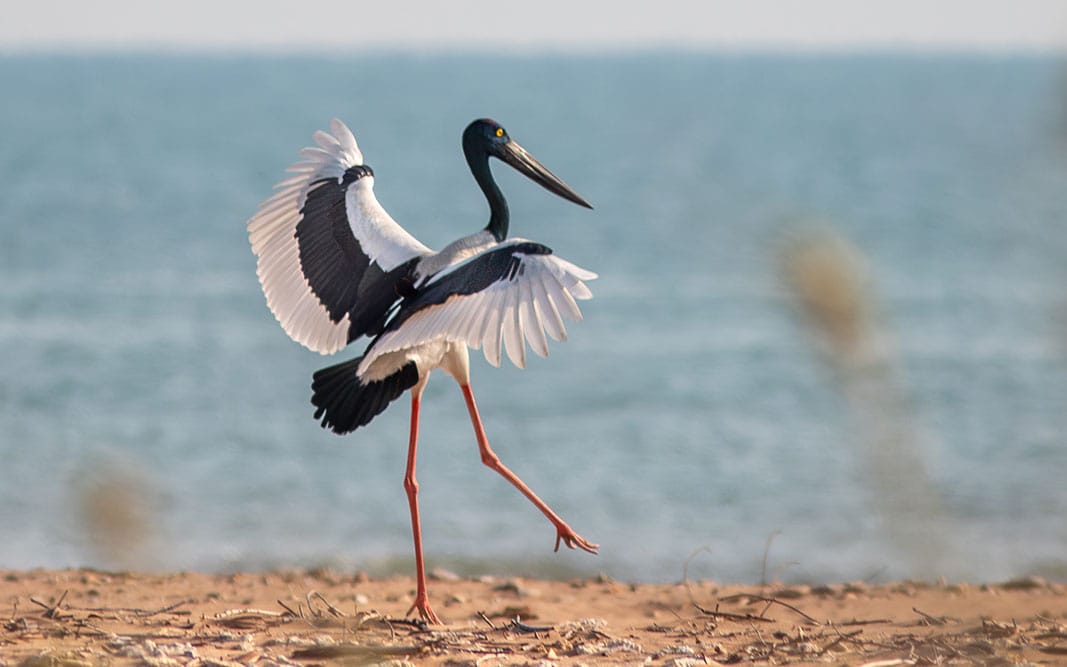
The Black-Necked Stork (Jabiru) — Sentinel of the Wetlands
In northern Australia’s wetlands, the black-necked stork, often called jabiru, stands like a living marker of water Country. With its towering stature and deliberate movements, it appears in stories that speak of kinship, journeys and transformation. In some traditions, the jabiru is part of ancestral narratives that explain relationships between people, animals and waterways — stories held within cultural law and shared through approved retellings and published works.
In art, the jabiru often appears as a symbol of abundance and wet seasons, its long legs echoing the channels carved by water over time.
The Frigatebird — Herald of the Storm
High above tropical seas and coastlines, the frigatebird rides unseen currents. With wings stretched impossibly wide, it drifts effortlessly — a dark shape against bright sky. For coastal communities across northern Australia, the sudden appearance of frigatebirds inland has long been read as a sign of change.
In Indigenous knowledge systems, frigatebirds are associated with weather and movement. Their arrival can signal the approach of cyclonic conditions, their mastery of air currents allowing them to sense and follow vast atmospheric shifts. In this way, the frigatebird becomes both messenger and warning — a bird that reads the sky long before humans feel the wind.
Artworks depicting frigatebirds often emphasise wingspan and elevation, reinforcing their role as observers of forces far beyond the horizon.
The Emu — Keeper of Paths and Sky
Few birds are as deeply embedded in Australia’s storyscape as the emu. Grounded and powerful, the emu appears in stories across many Nations — often as a creator being, a traveller, or a figure whose actions shape landforms and law. The emu is also written into the sky itself, in the famous Emu in the Sky, traced not by stars but by the dark spaces of the Milky Way.
This celestial emu governs seasonal knowledge — including when emus lay eggs and when food resources are ready — linking sky, land and life in one continuous story. On earth, emus appear in rock engravings, carvings and paintings, their long legs and rounded bodies rendered with quiet authority.
In storytelling, the emu often teaches lessons of responsibility, consequence and respect for Country — themes that continue to resonate through both traditional and contemporary Indigenous art.
Birds in Art and Symbolism
Across Australia, birds appear in Indigenous art as far more than decoration. They are carriers of knowledge — markers of season, movement and law. From bark paintings and sculpture to modern canvas and textiles, bird imagery expresses connection to place and ancestral memory.
Beyond Indigenous traditions, birds also inhabit broader Australian folklore — curlews calling outside campgrounds, cranes lifting from wetlands at dawn, storks standing motionless in flooded plains. Together, these stories form a shared cultural soundscape, grounded in listening.
Birds that dance, cry, soar and stride across Australia are not simply wildlife — they are storytellers themselves. Through art, myth and memory, they continue to remind us that listening is as important as looking, and that the land still speaks — often on wings.
Cultural Respect & Storytelling Note
The stories and symbolism touched on in this article are shared in the spirit of appreciation and learning. Across Australia, many bird stories are part of living Indigenous cultures and are held with deep cultural meaning. Some stories are sacred, restricted, or shared only within specific communities.
For this reason, this article avoids retelling cultural narratives in detail, and instead encourages readers to seek out Indigenous-authored books, artworks and resources where these stories are shared with permission and care. Listening to Indigenous voices — past and present — is the best way to understand the deep connections between birds, Country and story.
Story © Birding in Australia
Bird Images © Petra Hughes
(unless otherwise stated)
Please don’t copy, reproduce, or use any of the images or stories on Birding in Australia in any form without written permission.